

New Rules with Tony Cruz: Why Your Marketing Isn’t Bringing In Clients
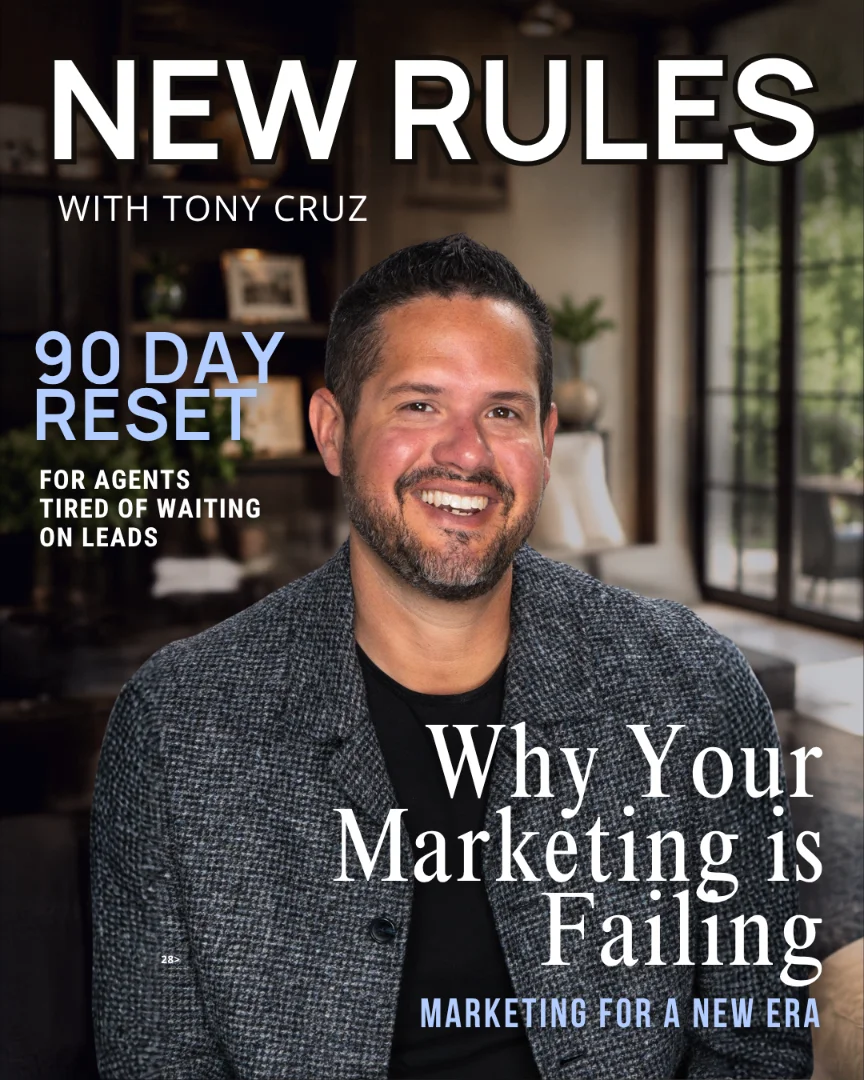
Tony Cruz spent two and a half years inside an ad agency. Now back at eXp, he’s answering the question many agents find themselves asking – Why is my marketing not working?
 Have you ever looked at another industry and wondered how they make getting clients look so effortless?
As Tony Cruz watched the appointment calendar at his wife’s med spa fill up week after week, he found himself asking the same question.
At the time, Tony had already built a substantial real estate career, growing a top-producing mega team at Keller Williams and helping agents build their own businesses. He had spent years learning how to create business, so he immediately noticed how the med spa’s ad agency was working from a completely different set of rules.
“I remember watching the med spa generate appointments consistently every week and realizing they weren’t relying on luck, referrals, or hoping the phone would ring,” Tony says. “Everything was measurable. They knew where leads came from, which messages worked, which offers converted, and how to improve results.”
Real estate, he realized, was often still operating on instinct. Agents bought leads, posted content, waited for a response and hoped their next campaign would be the one that finally clicked.
Tony wanted to see what would happen if he applied the agency’s approach to agent attraction. He asked the owner to test it with his ads, and the response was strong enough to get his attention. Soon after, he stepped away from full-time real estate to help run the agency. Over the next two and a half years, he led a team of roughly 35 people and worked around campaigns representing about $40 million in ad spend.
Now, Tony is back in real estate with eXp, building Apex Group in Orlando and bringing a different lens to the way agents market themselves. He learned how people decide to click, reply and book. More importantly, he learned why so much marketing gets ignored.
The Marketing Everyone Is Tired of Seeing 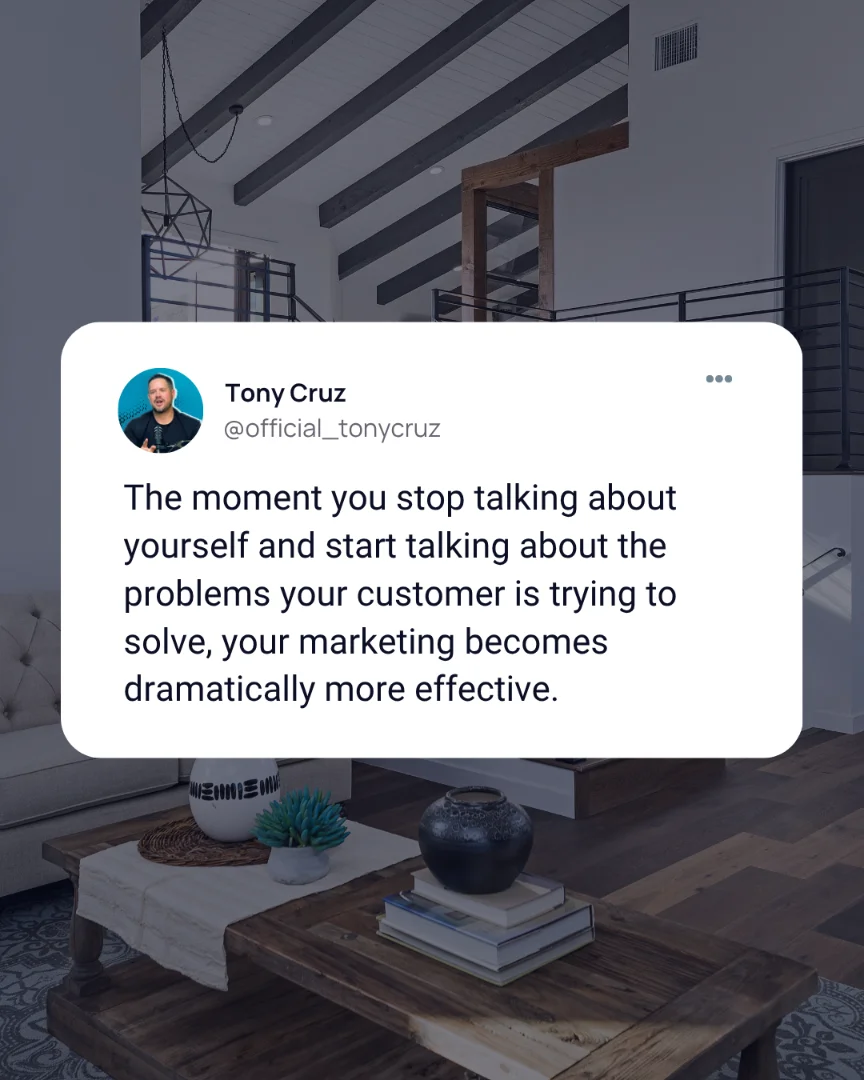
First things first, stop marketing your resume. Awards, production totals, years in business, a promise to help with all of someone’s real estate needs – those details are only useful once someone is seriously comparing agents. They rarely pull a person out of a scroll.
Instead, your marketing should sound like a client’s late night Google search. You need to speak directly to the conversation already happening inside a client’s head.
They’re wondering:
Will selling now leave them stuck without a next home?
Why is their online estimate different from the houses selling down the street?
Can their family afford a move or did they miss their window?
Will every home worth seeing turn into a bidding war?
Are they making a mistake by waiting?
“People don’t take action because they’re convinced,” Tony says. “They take action because they feel understood. People stop scrolling when they see themselves in the message.”
Instead of posting generic updates, share a specific story. Talk about how you helped a homeowner walk away with $80,000 in equity while keeping their monthly payment comfortable. Specificity makes your marketing feel incredibly personal.
"The moment you stop talking about yourself and start talking about the problems your customer is trying to solve, your marketing becomes dramatically more effective," Tony adds. “Review your last 50 conversations with buyers and sellers. The questions they ask repeatedly are the exact topics you should market.”
More Leads Will Not Fix a Message Nobody Cares About. Do This Instead.
Tony ran a marketing company, and he still talks agents out of buying more leads.
Buying more leads is often just a convenient way to avoid fixing a broken conversion process. Agents drop thousands of dollars chasing new internet traffic, but they completely ignore the people who attended their open houses months ago.
"The best agents I've worked with don't necessarily generate more opportunities than everyone else," Tony explains. "They simply do a better job converting the opportunities they already have."
When an agent tells him their marketing is not working, he looks at three things first:
The message: Does it speak to a specific concern?
The offer: Does the person have a useful reason to respond, beyond a vague invitation to “reach out anytime”?
The follow-up: Does anyone hear from you quickly, and do they have a reason to keep engaging after the first message?
That is where Tony separates the tools agents already use from the system many of them are missing.
Many platforms can help agents manage active clients, transactions and long-term relationships, but Tony sees lead management as a separate job. It starts much earlier, when someone clicks an ad, requests a home value, visits a listing page or walks through an open house.
That person needs to go somewhere other than a spreadsheet.
Tony uses GoHighLevel to organize those early signals and build follow-up around what each person actually cares about. A homeowner who requested a valuation should not receive the same messages as a first-time buyer who downloaded a neighborhood guide.
He uses his system to tag the lead, send the first email or text, remind the agent to call, and keep the conversation moving with useful follow-up. He also uses it to set appointment reminders, send voicemail drops, and nurture campaigns without manually recreating the process every time.
Speed has become part of the client experience and the right system will help facilitate that.
“Amazon ships faster. Uber arrives faster,” Tony says. “Consumers expect faster communication than ever before.”
Someone who fills out a form today is not likely to wait three days for an answer. The first response does not have to be a lengthy sales pitch. It can be a quick acknowledgement, the information they asked for, and a clear next step.
“The first professional to respond isn’t always the most talented,” Tony says. “But they’re often the one who gets the opportunity.”
Tony also uses voice AI and chat tools to handle basic questions and keep leads from going cold while an agent is in a showing, at an inspection or off the clock. The agent still handles the part that requires judgment: the strategy, the advice and the conversation that helps someone make a real decision.
Before adding another platform, Tony wants agents to map out what happens after someone raises their hand. What is the first message? When does the agent call? What happens if the person does not respond? What follow-up would actually help them a month from now?
“Technology amplifies systems,” Tony says. “It doesn’t create them.”
The old version of lead generation ended when someone filled out a form. The new version begins there. Your marketing has done its job when it brings the right person in. Your follow-up is what gives them a reason to stay.
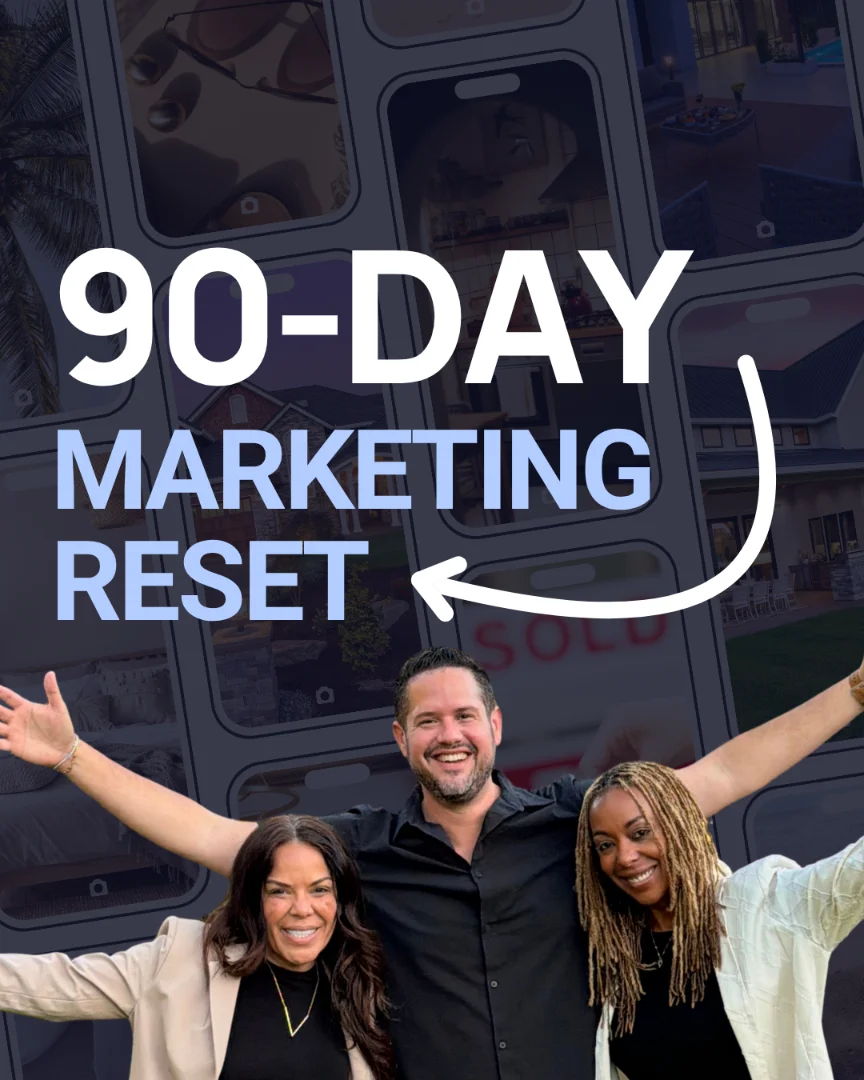 The 90-Day Reset for Agents Tired of Waiting on Leads
If you’re wanting to revamp your marketing strategy, here’s what Tony would do:
Days 1–30: Use real inventory to start conversations.
Tony would build relationships with agents on his team and local market, ask permission to promote their listings on Facebook Marketplace, and give the listing agent full credit. He would also reach out to builders and new-construction communities with approved social media policies.
Then, he would post every day: approved listings, new-construction opportunities, neighborhood content, and local market information. Facebook Marketplace matters here because buyers are already scrolling for homes, deals, and possibilities. They may not be looking for an agent yet, but they are looking for a place to live.
When someone messages about a property, pay attention to what caught their eye. Was it the price, the school district, the layout, the neighborhood, or the new-construction incentives? That answer tells you what to send next.
“Buyers don’t wake up wanting a Realtor,” Tony says. “They wake up wanting a home.”
Days 31–60: Give every inquiry a place to go.
Tag every inquiry by why that person reached out: a valuation request, a neighborhood guide, an open house, new construction, or a listing inquiry. Tony uses HighLevel to send the right first message, prompt the agent to call, and keep the follow-up moving with texts, emails, appointment reminders, voicemail drops, and AI-assisted responses.
A seller who requested a valuation should hear something different from a first-time buyer who clicked through a neighborhood guide. The personal conversation still belongs to the agent. The system makes sure the opportunity is still there when the agent is ready to have it.
Days 61–90: Follow the conversations.
By this point, the responses will tell you what deserves more of your time. Look at the posts, listings, neighborhoods, and messages that brought in actual questions and appointments.
If Facebook Marketplace is bringing in buyer conversations, post more approved inventory. If new construction is creating opportunities, deepen those relationships. If neighborhood content is getting replies, keep building around that topic.
Tony would wait to add paid advertising until he knew the message was working and the follow-up process could handle the response.
Your Next Client Is Already Looking for an Answer
Somewhere between the med spa appointment calendar that first caught his eye and the millions in ad spend that followed, Tony came back to real estate with a new instinct: the best marketing reaches people before they have fully figured out how to ask for help.
As he builds Apex Group at eXp, he is putting that instinct to work through stronger messages, smarter follow-up, and content built around the questions buyers and sellers are already carrying with them.
Your next client may be scrolling tonight, wondering why their home has not sold, whether their equity could fund a move, or how they will ever find the right next house. The agent who puts words to that question first is the one they remember.
Connect with Tony Cruz
