

Behind the Scenes: The Systems That Keep eXp Agents Moving
How eXp Builds Tools Around Agents (Not the Other Way Around)
 At eXp Realty, there’s no single headquarters where agents gather each day or a traditional office network. Instead, eXp operates as a cloud-based brokerage built for agents working from anywhere.
With more than 83,000 agents across dozens of countries, that model requires more than video meetings and messaging apps. It requires systems that can support agents at scale, like tools that keep communication organized, information accessible, and local markets connected to a global infrastructure.
Most agents don’t see the full scope of what happens behind the scenes, but they feel the difference when the right systems are in place. From international websites to internal platforms designed for collaboration, eXp has been investing in the digital foundation that helps agents stay connected, supported, and ready to do business.
Global Growth Requires More Than a Website
International expansion is one of the fastest-growing parts of eXp’s business, but launching in a new country takes more than announcing a new market.
Every new location requires essential infrastructure to be ready on day one: a localized website, a property search experience, integrations with local CRMs, and the ability for agents to establish an online presence quickly. When those pieces are delayed or inconsistent, it creates unnecessary friction for agents and confusion for consumers.
For years, eXp relied on vendors to manage country websites and related systems. Like many brokerages, the decision made sense at the time. But as the company expanded, the limitations became harder to ignore. Each country operated in its own silo with different tools and processes. Agent microsites were priced on a per-agent model, which meant costs increased as the company grew. Even small updates required waiting on outside timelines.
In one instance, eXp faced a major issue just before an international launch event. A vendor went on vacation shortly before the rollout, leaving eXp without a functional website for a market launch that involved hundreds of attendees.
Rather than scramble for another external solution, Sarah Hutchinson, who leads international marketing, used Lovable to build a new website internally.
“Sarah built it in Lovable, and it looked better than what we were going to get from the vendor,” said Seth Siegler, Chief Innovation Officer at eXp Realty.
That moment became a turning point and what began as a short-notice solution became the template for a larger shift in how eXp approached international website infrastructure.
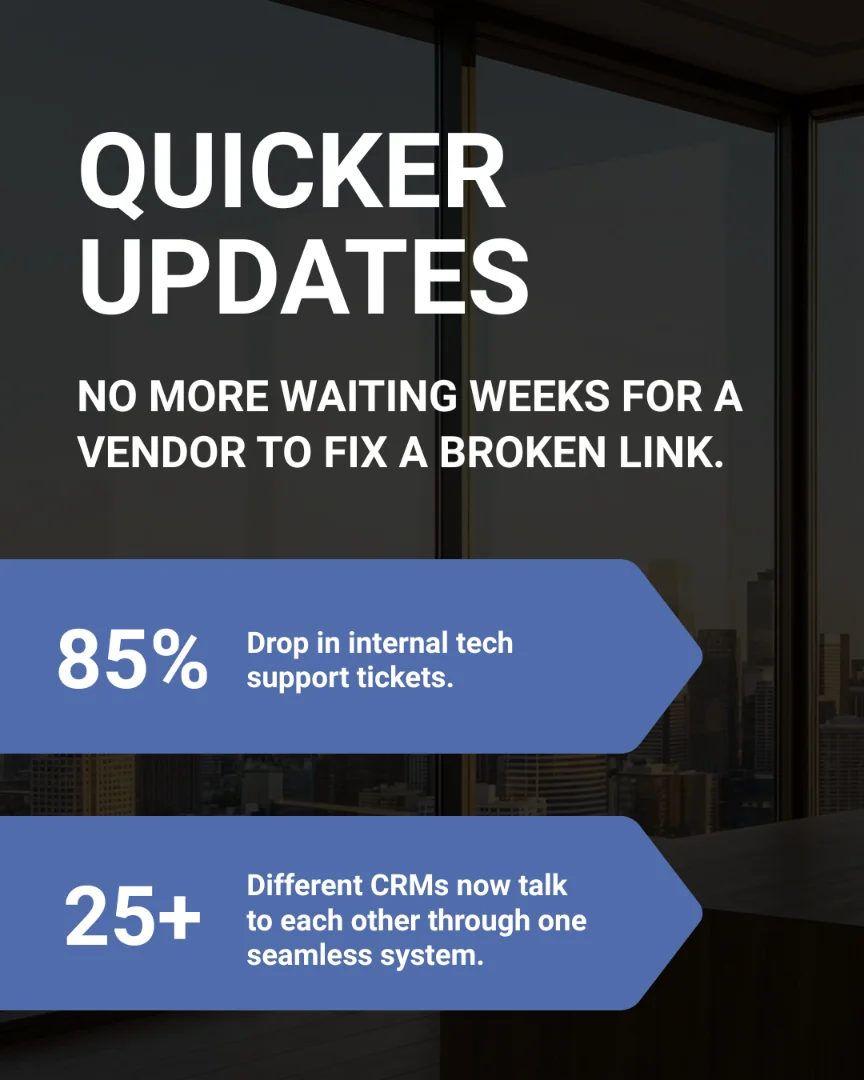
Instead of relying on a patchwork of third-party tools, the team built a scalable system that could support multiple markets more consistently. Using Lovable, they created a custom CMS for country sites, a self-service portal for agent microsites, and a backend service that normalized data from more than 25 different CRMs into a single API.
The result was not only faster execution, but long-term flexibility. With the infrastructure owned internally, eXp could update and improve these platforms without waiting on vendor roadmaps or negotiating new contracts every time a market’s needs changed.
 A Better Experience Often Looks Like Fewer Problems
When agents talk about the tools they rely on, they rarely focus on the technology itself. What they notice is whether the system works. Does it make their work easier? Cause delays? Do they have to submit support tickets just to accomplish basic tasks?
As eXp transitioned away from its previous vendor model for international websites, the results became measurable. After replatforming country websites and agent microsites, internal support tickets related to those systems dropped by 85%.
For agents, that kind of improvement translates into fewer interruptions and fewer technical barriers. It means less time spent troubleshooting, fewer broken links, and fewer situations where someone has to wait on a fix before they can move forward.
It also means that as eXp expands globally, agents can expect a more consistent experience across markets — something that becomes increasingly important as the company continues to grow.
Building Community at Scale Isn’t Automatic
Supporting agents goes beyond websites and marketing tools. For a cloud brokerage, strong communication systems and a sense of community play a major role in keeping agents connected.
For years, Facebook Workplace served as the central community platform for eXp. It helped agents stay informed, discover groups, and participate in conversations that extended beyond standard messaging. But when Meta announced the platform’s sunset, eXp had to pivot.
Instead of adding another expensive third-party platform to fill that gap, eXp chose to build its own.
Founder Glenn Sanford built The Hub using Lovable as an internal community platform, designed specifically to restore the discoverability and group workflows agents relied on.
“The Hub is built by us and for us so it gives us unique features that could never be offered by a SaaS provider who sells to a whole base of customers,” Siegler said. “Plus since we’re leveraging Lovable, we can iterate at warp speed.”
The Hub was unveiled at eXp’s annual conference in Miami and is owned and maintained internally, giving eXp the ability to evolve the platform over time as agent needs change.
AI Tools That Fit Real Workflows
The shift toward building internal tools did not stop with websites and community platforms.
As AI became more common across the industry, eXp began evaluating how these tools could support internal teams and improve operations. Many companies adopted enterprise chatbot platforms, but the costs often scaled quickly—especially in organizations where thousands of people need access.
Rather than relying solely on off-the-shelf solutions, eXp rebuilt custom chatbot functionality internally using the OpenAI and Google Gemini APIs. This approach allowed the company to tailor workflows to specific internal needs while eliminating per-seat pricing.
A Different Approach to Building at Scale
In most organizations, new tools must compete for space on an engineering roadmap. That often means the biggest company-wide initiatives take priority, while smaller problems remain unresolved for months or years.
At eXp, the approach has been shifting. Many of the tools now being developed internally are small, team-specific solutions that would never have been prioritized in a traditional development queue. But collectively, they remove friction across the company.
“We’ve been able to launch a lot of software that just never would have come up in a roadmap,” Siegler said.
That flexibility has become a defining advantage. Software decisions are no longer treated as permanent commitments. Tools can be built, tested, improved, and replaced as the business evolves.
In Siegler’s words: “Every SaaS is on the chopping block.”
When systems are built internally, they can evolve faster. When the people closest to the work can contribute to building solutions, the results tend to match real-world needs. And when the infrastructure behind the scenes is designed to scale, agents are less likely to feel the growing pains that often come with expansion.
Agents may never need to think about how international websites are deployed, how internal communication platforms are structured, or how AI workflows are designed. But they benefit from those systems every day.
As eXp continues to grow, the company is continuing to invest in systems that help agents work efficiently, stay connected, and access the support they need.
